.png)

UIP-8 : How Can Parents Choose the Right School for Their Kids?

1. Problem Statement ⚡
Every child deserves the chance to receive inclusive, equitable, and quality education, yet many families still struggle to find schools that truly support their children’s needs.
In our communities, parents often face confusion about how to choose the right school. Some schools rely only on textbook-based methods, while others promote Activity-Based Learning (ABL) and Inquiry-Based Learning (IBL)- approaches that make education joyful and meaningful. However, there are still schools where children face harsh discipline, limited extracurricular opportunities, or a lack of Child Protection Policy (CPP) and inclusion practices.
This raises an important question: How can each and every child get access to inclusive and equitable education that ensures learning, growth, and safety for all?
Through this project, students explored what “quality education” truly means, realizing that the right school is not just about academics but about nurturing curiosity, creativity, and character in every child.
To strengthen their understanding, students also learned about inclusive education, which means ensuring that all children, regardless of their background, gender, or abilities- have equal access to quality education. It values diversity, encourages empathy, and ensures that no child is left behind.
2. Project Description 🎭
Students of Grade 7 undertook a Unit Integrated Project titled “Help Parents Choose the Right School for Their Kids” under the theme Quality and Inclusive Education.

The project focused on helping parents and the community understand how to identify schools that offer a balanced and nurturing environment for both academic and emotional growth.
✨ Activities included:
• Community Survey: Students conducted surveys among nearby schools and within their community to understand different teaching styles, whether schools used textbook methods, ABL, or IBL and to assess classroom environments and child safety practices.
• Awareness Campaign: Students interacted with parents to spread awareness about the Right to Education (RTE), emphasizing that education is every child’s right and every parent’s fundamental duty to ensure their children attend schools that provide safe, inclusive, and meaningful learning experiences.
• Discussion & Analysis: In class, students discussed their survey findings, comparing schools that foster creativity and inclusion versus those that depend only on rote learning.
• Creative Expression: They designed posters, slogans, and charts to highlight the values of
child-centered learning and the importance of balancing academics with extracurricular growth. Examples included: “Every Child Deserves a Happy School!”
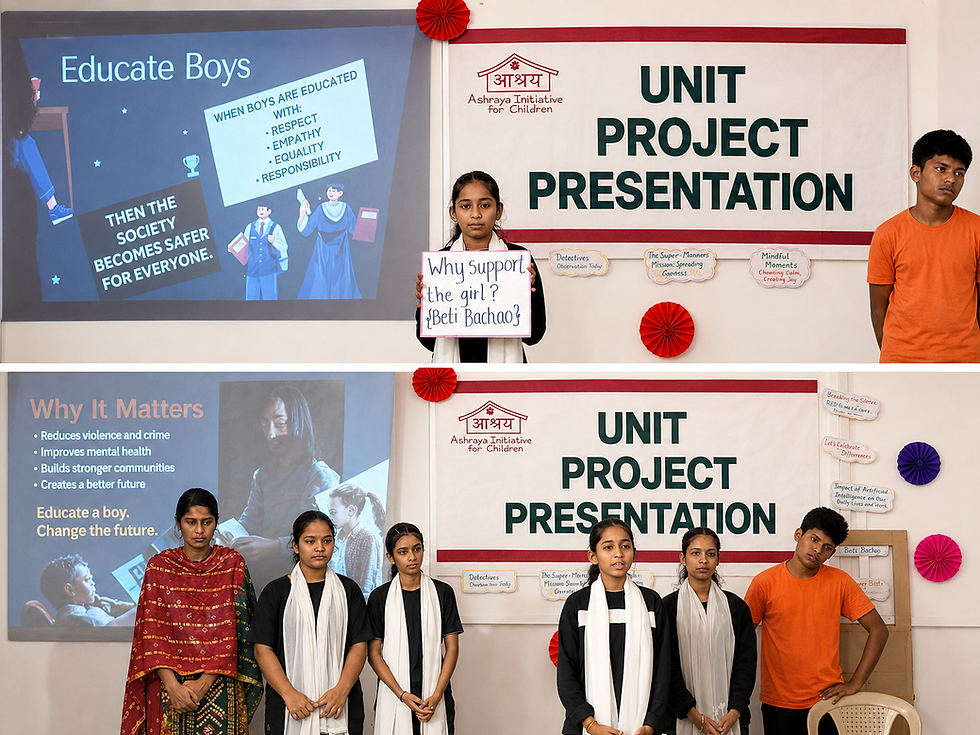
• Role Play & Presentation: Students presented a skit showing two types of schools - one that emphasized strict rules and memorization, and another that encouraged curiosity, collaboration, and compassion. The performance demonstrated that true quality education inspires both heart and mind.
3. Project Goals / Objectives 🎯
This Unit Integrated Project aimed to help students and parents understand the key principles of quality and inclusive education, and their shared responsibility in ensuring it for all.

Objectives:
📚 Increase Access to Education: Ensure every child has equal access to schools that foster learning, inclusion, and holistic growth.
✨ Improve Educational Quality: Promote modern, student-centered approaches such as Activity-Based Learning (ABL) and Inquiry-Based Learning (IBL) that make learning engaging and purposeful.
🌈 Support Inclusive and Equitable Education: Encourage schools to embrace diversity and support children of all abilities and backgrounds.
💡 Promote Lifelong Learning: Inspire curiosity, creativity, and critical thinking beyond textbooks, encouraging continued learning through online education, adult programs, and community learning centers.
🏫 Strengthen Community Involvement: Empower parents to take informed decisions, understanding that it is their constitutional duty to choose schools that respect every child’s Right to Education and ensure joyful, safe, and inclusive learning spaces.
4. Process and Timeline 🗓️
• Observation & Survey: Students surveyed nearby schools and local families to understand the real picture of education today, including teaching practices, learning environments, and safety measures under the Child Protection Policy (CPP).

• Research & Group Discussion:They analyzed their data and discussed how schools can become more inclusive, equitable, and child-friendly.
• Activities and Initiatives: In classrooms, students participated in group discussions on the importance of education and role-playing exercises to understand different perspectives. At the school level, they helped set up inclusive clubs and support groups, and organized events to raise awareness about equal education and inclusion.
• Creative Work & Presentation: Each group created charts, slogans, and performances to show how education quality depends on both teachers’ efforts and parents’ choices.
• Reflection: Students reflected on what makes their own school an example of joyful, balanced, and value-based learning.
5. Student Reflection 💭

📖 Education Is Every Child’s Right: Every child deserves access to schools that provide equal learning opportunities and respect their individuality.
🎨 Parents Are Key Partners: Parents have a crucial duty in ensuring their children attend schools that nurture not only intellect but also empathy and confidence.
🧩 Joyful Learning Builds Character: Activity-based and inquiry-driven learning develops curiosity, teamwork, and creativity.
🌍 Equality in Education Matters: Every child, regardless of background, should learn in a safe, inclusive, and encouraging environment.
💪 Change Begins with Awareness: By spreading awareness, students can guide their communities to make better educational choices and create positive change.
6. Closing Thought 🌟
Our students and parents realized that a truly good school doesn’t just produce high marks , it builds strong minds, kind hearts, and confident voices.
Quality education is the foundation of equality, and when parents make informed, value-driven choices, the entire society moves forward.
At Ashraya, we believe that education must light the path to empowerment and that begins with the right school for every child.
7. Call to Action ✊
Let’s join hands to ensure that every child learns in a school that educates with heart and purpose.
✨ Choose schools that nurture curiosity and compassion.
✨ Support learning spaces that value both knowledge and kindness.
✨ Encourage parents to make education a shared family responsibility.
When we stand for quality, we stand for every child’s right to dream, learn, and thrive.
✋ Take the pledge: “Every Child Deserves a Quality Education - It’s Their Right and Our Duty.”
👉
Contribute here: ashrayainitiative.org/donate


Comments