.png)

UIP-12: If Periods are natural, why the silence? Breaking the taboos

1. Problem Statement ⚡
Menstruation is a natural biological process, yet, even in the 21st century, it continues to be surrounded by silence, stigma, and deep-rooted misconceptions.
For many adolescent girls, periods are not just a physical experience but a social challenge. They are often made to feel embarrassed or “impure,” restricted from entering kitchens or temples, excluded from daily activities, or asked to isolate themselves. At the same time, many lack access to accurate knowledge, affordable menstrual products, and safe sanitation facilities.
These taboos go far beyond cultural practices - they directly affect girls’ health, confidence, and education. Many miss school due to pain, fear of staining, lack of hygiene resources, or teasing by peers. Silence further deepens misinformation, especially when conversations around menstruation are avoided both at home and in schools.
This project therefore explored a crucial question: If menstruation is natural, why is it still hidden in silence and how can awareness transform mindsets into acceptance and support?
2. Project Description 🎭
Students of Grade 8 undertook a Unit Integrated Project titled “Breaking the Silence (Red is Not a Curse - Periods are Power)”.
The essence of this project was to replace shame and myths with scientific understanding, dignity, and open dialogue, while empowering students to become advocates of change in their own communities.
Through a structured and experiential approach, students moved beyond textbooks, engaging with real-life situations, community beliefs, and practical solutions.
✨ Activities included:
• Role Play Performances: Students brought real-life scenarios to stage - highlighting stigma, teasing, restrictions, and myths, while presenting science-backed perspectives to challenge them.

• Survey and Data Collection: Students conducted surveys to assess awareness levels, affordability of menstrual products, and prevailing social beliefs.
• Field Visit: A visit to Mahila Udyog Kendra, Yerwada introduced students to sustainable menstrual hygiene practices and reusable cloth pads.
• Cloth Pad Making Activity: With guidance from a parent, students

designed and stitched reusable pads, transforming
learning into a hands-on, confidence-building experience.
• Expert Interaction: Doctors provided scientific clarity, reinforcing that menstruation is natural and that social restrictions have no medical basis.
• Awareness Discussions: Conversations with teachers, parents, and community members helped identify and question deeply rooted taboos.
• Hygiene Awareness Campaign: Students emphasized the importance of clean toilets, proper disposal, and access to menstrual products.
• Advocacy through Slogans: Strong, impactful messaging helped amplify the idea that menstruation is normal, and dignity is a right.
To deepen understanding, students used a structured three-point framework to analyze common period taboos - understanding their origin, the misconceptions that followed, and the scientific truth.
Three-Point Framework:
What ancestors actually said (original intention - often for rest or protection)
What people later misunderstood (myths, stigma, discrimination)
What science says (facts, correct practices, and solutions)
Key taboos addressed included:


.


3. Project Goals / Objectives 🎯
This Unit Integrated Project aimed to build awareness, challenge stigma, and promote menstrual health through knowledge and action.

Objectives:
💡 Normalize Menstruation: Help students understand that menstruation is a natural biological process, not something shameful.
🧼 Promote Hygiene Practices: Build awareness about safe menstrual hygiene, including the use of sanitary products, clean toilets, and proper disposal.
🔍 Identify Social Barriers: Enable students to recognize stigma, restrictions, and gender-based discrimination associated with menstruation.
📊 Develop Research & Analytical Skills: Encourage data collection, interpretation, and understanding of real-world menstrual health challenges.
🗣️ Encourage Open Dialogue: Foster safe spaces for boys and girls to communicate, support each other, and break the culture of silence.
🌍 Drive Community Awareness: Extend learning beyond the classroom to influence families and the wider community.
📚 Integrate Academic Learning with Real Life: Connect concepts from Science, Social Science, Mathematics, Languages, Arts, and Life Skills to real-world issues—enabling students to apply knowledge meaningfully while building empathy, confidence, and problem-solving abilities.
4. Process and Timeline 🗓️

• Introduction and Awareness: Students began by discussing menstruation, myths, and its impact on daily life.
• Survey and Data Collection: They gathered insights on awareness, beliefs, and challenges related to menstruation.
• Field Exploration: Visits to Mahila Udyog Kendra provided exposure to sustainable hygiene solutions.
• Expert Interaction: Doctors addressed misconceptions and explained the science behind menstruation.
• Hands-on Learning: Students engaged in cloth pad making, reducing hesitation and building confidence.
• Creative Expression: Role plays and slogans were developed to communicate powerful messages.
• Community Engagement: Discussions with parents and community members helped challenge long-standing beliefs.
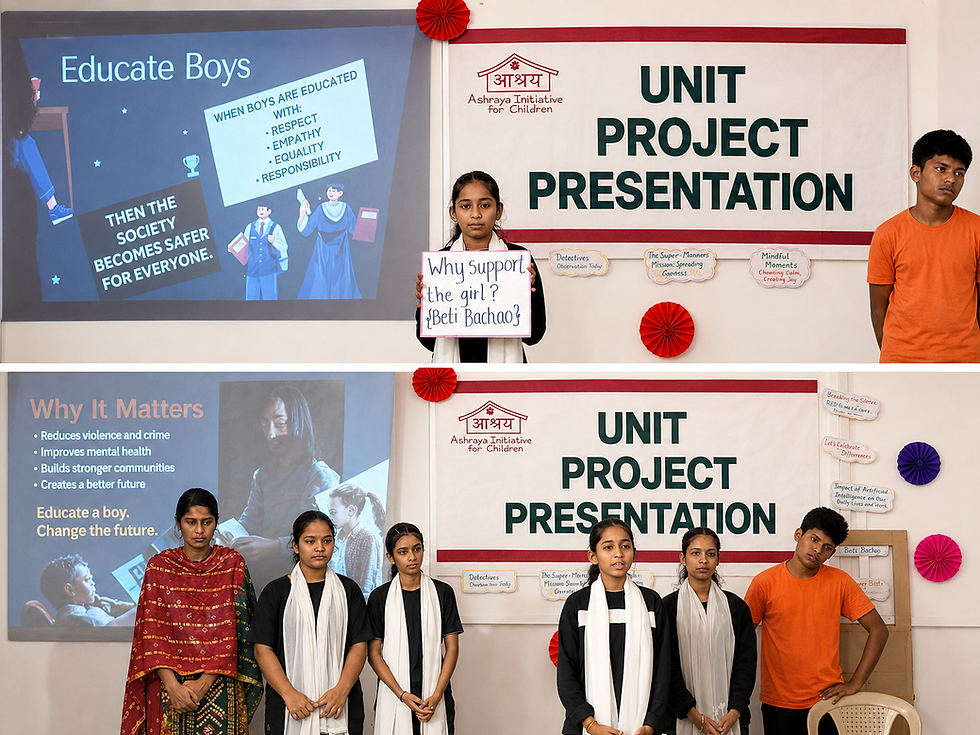
• Presentation and Outreach: Students showcased their learnings and advocacy efforts to the wider community.
5. Student Reflection 💭

💭 Breaking the Silence: Students realized that menstruation is natural and should not be hidden or stigmatized.
🧠 From Myths to Science: Expert sessions helped replace misconceptions with factual understanding.
🛠️ Confidence Through Action: Activities like cloth pad making reduced fear and hesitation.
🤝 Empathy and Support: Students understood the importance of supporting peers and creating safe spaces.
🔍 Awareness Beyond Self: They recognized the need to spread awareness within families and communities.
They reflected meaningfully: “When we replace silence with knowledge, we replace shame with strength.”
6. Closing Thought 🌟
“Breaking the Silence” was not just a project, it was a step toward dignity, awareness, and equality.
At Ashraya, we believe that every child deserves access to knowledge, health, and respect. Through guided learning and expert support, students not only understood menstruation scientifically but also challenged societal norms with confidence.
By empowering both girls and boys to speak openly, this initiative fostered a culture of respect, empathy, and informed choices - ensuring that no child feels ashamed of something that is completely natural.
7. Call to Action ✊
Let’s break the silence and build a world where menstruation is treated with dignity and understanding.
✨ Normalize conversations around periods
✨ Ensure access to safe and affordable hygiene products
✨ Challenge myths with science and awareness
✨ Encourage boys and girls to support each other
Because periods are not a problem - silence is.
👉 Support Ashraya’s mission to promote health, dignity, and holistic development for every child.
Contribute here: ashrayainitiative.org/donate


Comments